Saturday, December 31, 2016

2016 in review

2016 has been a good year for political writers and late night comedians due to the presidential election and the surprise of Trump's victory over Clinton. There have also been other events that have happened in 2016, so here is a list of my favorite news stories from this past year (in no particular order). This short list is only a scratch on the surface of what all has happened this past year, nonetheless, it gets the job done. I hope you enjoy reading this and Happy New Year! Catch ya on the flip side.

Univ. of Chicago pushes back on trigger warnings, safe spaces
I wrote about this one already, but I liked this story because it somewhat restored my faith in American colleges and universities. Trigger warnings and safe spaces are only making Millennials softer than they already are (talking about my generation).

You Are Here


Is Society Destroying the Kind of Women Men Want?
This article accurately describes trends in my generation that are annoying to me, particularly the part about self-esteem. All I ask is that you read the article before assuming I'm sexist.

Brexit
That link is the best article I could find for Brexit.

Trump wins presidency, defeats Clinton in historic election upset
Trump's victory over Clinton was a good surprise to me.

Our Founding Fathers are wiser than many people give them credit for.

I just thought this article was entertaining. The media won't admit that Obama is trying to sabotage Trump's presidency, but clearly the Russians see it.


Nico Rosberg finishes second, wins first Formula One title


Stephen Curry wins MVP for second straight season
If you couldn't tell by now, I'm a Stephen Curry and Golden State Warriors fan. I'm not going to talk about the Finals though.

Tuesday, December 6, 2016

Trump's "risky" Phone Call

This comes as no surprise to me, but the liberal media outlets are losing their minds over Trump's call with Tsai Ing-wen, the newly elected Taiwanese President. CNN reported, "US officials have talked at least twice with Beijing amid concern that President-elect Donald Trump was endangering ties between the two countries after his conversation with Taiwan's leader last week, the White House said on Monday." U.S. News & World Report published an article titled "Donald Trump’s Taiwan Call Signals Rocky and Potentially Dangerous Diplomacy Ahead". The Guardian, what a noble name, called Trump's call a "Gaffe or provocation, Donald Trump's Taiwan phone call affects global stability". I could go on with more links, but you see my point.

I know the media's freaking out about this call because Trump is threatening to change the dynamics of, the media's golden boy, Obama's, globalist policies. They don't want Trump to fail so the Democrats can get back in the White House in four years, so everything that Trump does will be criticized by the media monster that we have. It's not only about Chinese-US relations, it's who the president-elect is.

I don't see how the phone call between Trump and Tsai Ing-wen endangers anything. They just congratulated each other about their respective accomplishments in democratic elections. Trump didn't encourage Tsai Ing-wen to break away from China or anything like that. I think it's a good thing, actually, for Trump to speak with a Taiwanese president considering no American president has done so since 1979. 

Trump isn't trying to start a war, he's just shaking up the world order a little bit. Obama had his chance to bring about change and he didn't do it, so it's Trump's turn now.

I'm going to quote a Fox News article about this, "The fact that a simple courtesy call caused so much trepidation and genuflections to past protocol just shows how absurd U.S.-China policy has become. If a little courtesy to a democratic friend and a little truth about Taiwan could really threaten peace in the Pacific, as the experts contend, then we need to reevaluate our defense and come up with something better."

I mean I could be wrong and Trump could've just started World War 3, but I don't believe he has.

Thursday, November 17, 2016

I'm a Christian first and a Conservative next

So far I haven't done an adequate job of letting people who read this blog know that I'm a Christian. As a Christian, I'm instructed to spread the Word of God (Matthew 28:19Mark 16:15-16Psalm 96:3). My faith in Christ is something that I value and the Bible influences the way I make important decisions (1 John 5:3Proverbs 3:5-6). I'm sharing my hope in Christ on this blog not only because I want others to know of and experience the hope I have in Jesus, but it's also important for readers to know what my morals are based on. 

Some people say that the Bible shouldn't be anywhere near politics, however, I ask: If you don't base political decisions on the Bible, then what do you base it on? I mean that sincerely, it's not sarcasm. It's vital to know what someone believes, or their when reading things that they write. If you don't know what they believe, then you can be misled or you can read too much into their works. This concept applies to all written works, not just opinion articles on blogs, but fiction books, non-fiction books, poetry, news articles, etc. 

I had an English instructor in college that told me the author's intentions and background don't matter. They just don't matter. His reasoning was that all written works are meant to be interpreted. To me that takes every strand of importance out of a written work and converts it to meaningless garble on paper. It's useless to even read by that belief.

The other point I want to emphasize is worrying about who gets elected. I'm talking being worried as opposed to being concerned. Being concerned about who gets elected is good concern to have and it motivates people to go vote. Voting is a great attribute of a democratic government and I encourage everyone to vote, Christians an non-Christians alike. Now, being worried about who gets elected is not a good thing. Whether a leader is good or evil they have been allowed to rule by God (Romans 13:1-6). Regardless of who gets elected God will never abandon you (Deuteronomy 31:6), so there is no need to worry (Matthew 6:25-34). God has a plan for everything and everyone (Jeremiah 29:11Revelation 21:1-7Psalm 23:1-6).

My example of this is the most recent election. I know people who were scared to death that Clinton would get elected and I know people who were scared to death that Trump would get elected. Some of these people were Christians at that. I was genuinely concerned about a few friends during the election. By no means am I criticizing these people, I'm just as guilty of being scared and anxious about things. However, I wasn't scared about who would get elected and I give all the credit to God. God is the one who is in control, not a political candidate. Politics only matters in this world. And this world is not our home, we're waiting on our home (Hebrews 13:14).

Friday, November 11, 2016

The Election is Finally Over

Trump is not my ideal candidate for president, but I voted for him because I'm willing to give the man a chance. I'm asking everyone who reads this to give Trump a chance before you start criticizing him. I'm not naive, so I know most people aren't going to give him a chance, but it's worth a shot. And I accept that I, and other Trump voters, will be looked down upon by the news media and by ignorant folks on social media as xenophobic, racist, or bigoted (or maybe even all three). If you know me, then you know I'm not xenophobic or things like that. I'm not perfect by any means, but I do care about the citizens of this country regardless of race or nationality.

I voted for Trump because I don't think Clinton would lead our country in a positive direction due to her corruption. I would have voted for anybody other than Trump if I thought he would destroy the country or become an autocrat. I truly don't believe that Trump is going to be the end of our country, I believe that he has the potential to be a good leader.

Most of this hatred of Trump supporters comes from people who are too immature to accept the result of the. Some people have gone as far as blaming the electoral college and the sovereignty of a constitutional republic. I saw a post on Facebook today criticizing the electoral college saying that it's an old idea and it gives us presidents nobody wants. Well, using that logic: Obama won the electoral college vote, so that must mean that nobody wanted Obama as president. 

Not everyone who didn't vote Trump is angry at Trump voters, the majority of America is calm. For those people out there who are acting civilized, thank you for not going ballistic. I'm not asking you to like Trump, but let's not divide our country. You can love your country without liking the president at the time.

As Abraham Lincoln said, "A house divided against itself cannot stand." The only way America survives is if we can unite as Americans. I hope and pray that our country will be more unified one day. 

Friday, October 21, 2016

We the People Don't Need a President's Plan

This article was originally posted on FEE.org. I think it is very well written and informative. The Constitution of the United States is one of the best legal documents ever written and it should be protected. All credit for this article goes to Barry Brownstein, professor emeritus of economics and leadership at the University of Baltimore. Enjoy!

We the People Don't Need a President's Plan

Hillary Clinton has a “plan.” I live in a “battleground state” so Clinton shared her plan with me in commercials, over and over and over again, through Saturday afternoon college football. Clinton’s plan is to spend more taxpayer money. Her spending initiatives include free college tuition for students in families making under $125,000 a year, universal preschool, and subsidized child care.

Delegated authority to the president is quite limited in the Constitution, but no matter. In our increasingly post-constitutional America, candidates, the media, and a majority of the public seem to believe that the president has powers far beyond those given by the Constitution. Do you remember Bill Clinton claiming his plan was building a  “bridge to the future”? “Building” plans are de rigueur for candidates. We have come to believe that the president has a problem solver’s job to fix a whole host of domestic and foreign issues.

Hillary tells us she is “fighting for us.” Since she is “fighting for us,” shouldn’t we be glad she has a plan?

What Does “We the People” Mean?
The preamble to the Constitution famously says: “We the People of the United States, in Order to form a more perfect Union, establish Justice, insure domestic Tranquility, provide for the common defence, promote the general Welfare, and secure the Blessings of Liberty to ourselves and our Posterity, do ordain and establish this Constitution for the United States of America.”

James Madison wrote, “Measures are too often decided, not according to the rules of justice and the rights of the minor party, but by the superior force of an interested and overbearing majority.”

But what does “We the People” mean? In this interview law professor Randy Barnett addresses that question as he talks about his important book Our Republican Constitution: Securing the Liberty and Sovereignty of We the People. He explains that today “We the People” is commonly interpreted as a collective of people who can vote their preferences into law by majority rule and then implement their will against the will of individuals whose rights are ignored. When judges rule laws as unconstitutional they are seen as the problem because “they get in the way of the will of the people.”

More and more Americans want to be taken care of by government; they want wealth to be redistributed by government too. They believe all that is needed to expand the role of government is a vote. The framers of the Constitution understood that democracy is no guarantee against liberty being usurped. In Federalist Paper No. 10, James Madison wrote, “Measures are too often decided, not according to the rules of justice and the rights of the minor party, but by the superior force of an interested and overbearing majority.”

Madison and the other framers of the Constitution had something very different in mind than being subjected to rule by an “overbearing majority.” Barnett looks to the Declaration of Independence as an essential document by which we can better understand the Constitution. He says the alternative reading of “We the People,” is “We the People as individuals, each of whom are endowed with the individual rights of life, liberty and pursuit of happiness.” Government’s role then is to “secure these rights.” Barnett points out that the Founding Fathers believed that “first comes [pre-existing and inalienable] rights, then comes government.”

You don’t have to look far to find support for Barnett’s position. James Wilson was a signer of the Declaration of Independence and was one of the six original justices appointed by Washington to the Supreme Court. Here, quoted by historian Brion McClanahan in The Founding Fathers Guide to the Constitution, Wilson explains what “We the People” of the United States means:
“We the People — it is announced in their name, it is clothed with their authority, from whom all power originated and ultimately belong. Magna Carta is the grant of a king. This Constitution is the act of the people and what they have not expressly granted they have retained.
Wilson was no outlier in his interpretation of the Constitution. James Madison was the chief architect of the Constitution and in Federalist Paper No. 45 he puts it clearly: “The powers delegated by the proposed Constitution to the federal government are few and defined.”
If the powers allocated to the federal government are “few and defined,” how could the president have a plan other than to defend the liberty of the people?

Rights are Retained by the People
So how do we keep government to a few and defined powers? Some founding fathers wanted a Bill of Rights as a bulwark against government. Others, including Alexander Hamilton, feared government would grow if the rights of government were itemized. In Federalist Paper No. 84 Hamilton argues against the Bill of Rights being incorporated into the Constitution:
"They would contain various exceptions to powers which are not granted; and on this very account, would afford a colorable pretext to claim more than were granted. For why declare that things shall not be done which there is no power to do? Why for instance, should it be said, that the liberty of the press shall not be restrained, when no power is given by which restrictions may be imposed?"
In other words, as James Wilson puts it “a Bill of Rights annexed to a Constitution is an enumeration of the powers reserved. If we attempt an enumeration, everything that is not enumerated is presumed to be given.” Imperfect enumeration of powers would imply that government has powers it does not have.

There was no argument about the rights retained by the people; the argument was how to secure them. Madison’s solution to those objections was the Ninth Amendment. Placed in its historical context, the powerfully simple language of the Ninth Amendment is clear and unambiguous: “The enumeration in the Constitution, of certain rights, shall not be construed to deny or disparage others retained by the people.”

What Madison couldn’t have anticipated is that the courts would virtually ignore the vital Ninth Amendment, citing it only in a few cases in the course of American history. Ignoring the vital Ninth Amendment has helped to allow government to expand unchecked. Randy Barnett’s edited volume The Rights Retained by the People is an essential guide to the Ninth Amendment.

The Powers of the President
The powers granted to government are “few and defined.” The Constitution grants the president only a few of those limited powers and, certainly, no power to propose grand plans. In his book The Founding Fathers Guide to the Constitution Brion McClanahan writes:
“The framers did not consider the president to be the chief legislator. He could not propose legislation and his primary domestic responsibility was to execute the laws and carry ‘the will of the legislature into effect.’”
So limited were the powers of the president that Charles Pinckney, founding father and signer of the U.S. Constitution, argued against the impeachment clause in the Constitution on the grounds that the president’s powers “would be so circumcised” by the Constitution that presidential abuse would be impossible.

If the president is not to make plans for us, then what? In my FEE essay There is No Such Thing as a Political Problem Solver, I put it this way: “Every day, ordinary citizens and entrepreneurs pursue opportunities. No one controls the myriad decentralized decisions and actions that, along the way, solve problems. We don’t need “problem solvers” to tell us the “winning plan.” We need planners and “problem solvers” to stay out of our way.”

In reality, Clinton’s plan is not the problem. Her plan to expand government only reflects the hearts and minds of American people who are ignorant of and no longer value our great founding principles. The analysis in this essay would be considered irrelevant by many Americans—who would say the Constitution must be interpreted in light of what society needs today. As for the rest of us, in Barnett’s words, “As long as the Constitution has not been repealed, we could appeal to restore it… We’re going to have to figure out how to keep the flame of liberty alive and how to keep the Constitution alive, at least in our thoughts, until we have a change in circumstances.”

A “change in circumstances” will begin when we change our minds about the role of government. When we no longer believe we need a president’s plan, candidates will stop offering them. We are the problem and we are the solution.
Barry Brownstein
Barry Brownstein is professor emeritus of economics and leadership at the University of Baltimore. He is the author of The Inner-Work of Leadership. He delivers leadership workshops to organizations and blogs at BarryBrownstein.com, and Giving up Control.
This article was originally published on FEE.org. Read the original article.

Thursday, October 6, 2016

Vice Presidential Debate musings

The VP debate Tuesday night was the first full VP debate that I've seen and it did not disappoint me. Pence clearly won the debate because Kaine was on the defensive from the start. Kaine couldn't get himself refocused on policies and facts, which lost him the debate. 

Kaine interrupted Pence 72 times. Think about that for a moment folks, 72 times. Kaine's strategy seemed to have been this: "I'll interrupt Pence every time he speaks the truth and then Quijano will finish him off with tough questions." That's not a respectful way to debate, you should be polite enough to allow your opponent to finish speaking before you speak. I thought we all learned this in first grade: don't interrupt others, it's disrespectful and annoying. Kaine came across disrespectful and annoying.

In this election, the Clinton campaign has been attacking Trump's demeanor, but Kaine, during the debate, had a worse demeanor than Trump. It seems contradictory for the Clinton campaign to criticize Trump for his demeanor in light of Kaine's behavior last night.

Pence, on the other hand, mostly let Kaine finish his thought and then capitalized on Kaine's mistakes. I'm actually going to quote a Washington Post article"Pence was the more comfortable of the two men on the debate stage. Pence repeatedly turned to the camera when he answered questions, making clear he understood that the real audience wasn't in the room but watching on TV. The Indiana governor was calm, cool and collected throughout — a stark contrast to the fast-talking (and seemingly nervous) Kaine." Pence does what Trump doesn't, and that is stay cool and collected. Pence was like a airplane pilot: even though there was turbulence, he wasn't nervous.

I'm not going to get too much more in depth or break down every little exchange in the debate because the media has that covered. (I think the media were sharpening their pitchforks during the debate in preparation for their post-debate criticism mob.) Anyway, I thought Pence did a great job representing the Trump campaign in the debate Tuesday. Trump could learn a thing or two from Pence on debating.

This isn't in Kaine's defense, but he was probably doing exactly what the Clinton campaign wanted him to, which was to sling mud. It didn't matter how much mud ended up on Kaine, the only thing that mattered was that more mud hit Trump through Pence. Kaine, according to some pundits, doesn't usually behave in such a behavior. That was the sacrifice he was willing to make for the campaign.

That probably says something about our political system, that some VPs are just there to be character assassins instead of an actual asset. That's a sad statement to make, one I wish I didn't believe. 
----------------------------------------------------------------------

In the words of Forrest Gump, "That's all I have to say about that."

Tuesday, October 4, 2016

How to Vote for President When You Don’t Like the Candidates

The following article is originally from a website called The Conversation; I don't know anything about this website, but I found this article to be pretty interesting. So, all credit goes to Aradhna Krishna, University of Michigan and Tatiana Sokolova, University of Michigan. Anyway, enjoy the article.


How to vote for president when you don't like the candidates

Aradhna Krishna, University of Michigan and Tatiana Sokolova, University of Michigan

How do voters select a candidate when no one they like is on the ballot?
Behavioral scientists have studied decision-making – including voting – for decades. However, researchers usually give respondents at least one appealing option to choose from.

This led us to wonder: What do voters do when they consider all of the options bad? Do they fall back on party affiliation, or simply toss a coin? This question is especially appropriate in the current presidential election because the two front runners have the lowest favorability ratings ever.

When we did research to answer this question, we learned that in situations where all of the choices are bad, people tend to vote by rejecting the choices they didn’t like, rather than by affirmatively choosing the one they disliked least.

Imagine there are two undesirable candidates named Tilly and Ron. Given this “two bad choices” option, voters will be more likely to select Tilly because they reject Ron, rather than select Tilly proactively.

While the end result may be the same, the thought process that leads to this decision is quite different.
As behavioral scientists who study how people make decisions, we think this distinction could affect the upcoming presidential election. If people select between Clinton and Trump by using rejection rather than choice, then the information they use to make their decisions will be different.

In some ways, it may be better. Voters using rejection are more deliberate. They are less likely to be swayed by unimportant information about a candidate that they read or hear on radio, television or Facebook. They may pay less attention to rumors. In fact, conscientious voters may be well served to actively adopt a rejection strategy for their vote in order to make a choice more deliberately.

Choosing to reject

In a study we ran online in April, we showed people only Hillary Clinton and Donald Trump as the two candidates for president. Those who found at least one of them attractive were more likely to select by choice, while those who disliked both were more likely to select by rejection.

Having determined that people use rejection strategies to make their voting decisions in bad-option situations, we next wanted to test how rejection strategies would change the information people focus on.

In nine separate studies we conducted, some of which will be published in an upcoming Journal of Consumer Research, we found that when people use rejection strategies, they also become more deliberate in their decision-making. In other words, they pay more attention to all information they have – both good and bad – and don’t get swayed as much by one piece of information that sticks out.
In our research, we saw more deliberation in rejection decisions and less of a tendency to be swayed by emotional, in-your-face information.

For example, one of these studies determined that people were less likely to vote based on party affiliation if they voted by rejection, rather than by choice. Respondents also took less time to make their decision in the choice condition versus the rejection condition.

Revisiting an old favorite

We reached these results by revisiting a classic study known as the “Asian disease problem.”
The Asian disease problem was first proposed by the behavioral economists Daniel Kahneman and Amos Tversky in 1981. It is well-studied because of the contradictory choices people make, and is one of the many conundrums that Kahneman proposed which later won him the Nobel Prize.
In the standard formulation of the Asian disease problem, people choose between two programs to combat an unusual Asian disease: program A, which offers certainty; and program B, which involves a risk.

The original research showed that people change their preferences between the two programs depending on how the options are described.

People tend to select the more certain program A if it is framed as a gain. Specifically, 72 percent of respondents preferred (A) “200 people are saved out of 600” while 28 percent picked the riskier (B) “1/3 probability that 600 people are saved and 2/3 probability that no one is saved.”
That may seem rational. However, change the wording and the results also change – even though the theoretical loss of life remains the same.

Program A was preferred by only 22 percent of the recipients when researchers framed the choice like this: (A) “400 people will die out of 600” versus (B) “2/3 probability that 600 people will die and a 1/3 probability that no one will die.” With this wording, 78 percent choose the riskier option. This is because people tend to focus on emotionally salient information like “save” and “die.”

Emotional appeals less powerful

Our new research revisits this classic problem to study what would happen if the respondents were choosing which program to reject instead of which one to choose. Would people be swayed less by the attention-grabbing words like “save” and “die”?

When we asked respondents which program would you reject, respondents’ selections were affected less by the use of the emotional words. Program A was selected by 48 percent in the first pair and 43 percent selected it in the second. In other words, the decision between program A and program B was similar, whether “save” or “die” was used to describe the programs.
The study results indicate that wild in-your-face claims made by candidates will get less weight if people use rejection strategies to vote.

Princeton psychology scholar Eldar Shafir has also found that rejection makes people focus on negative attributes. Perhaps the candidates’ campaign managers know this already and that is why the negativity in this election has been so high. But, the point to remember is that this cannot be a shallow negative attribute like sounding bossy or having a spray-tanning habit. People voting by rejection will be more deliberate – and will look carefully at what makes a candidate bad. Emotional claims will not work. Voters will think carefully about why they want to reject one of the candidates.

The Conversation
Aradhna Krishna, Dwight F Benton Professor of Marketing, University of Michigan and Tatiana Sokolova, Post-doctoral Researcher, University of Michigan

This article was originally published on The Conversation. Read the original article.

Thursday, September 22, 2016

Rioting in Charlotte

Most of you readers are probably from North or South Carolina, so you know about the rioting in Charlotte going on this week. If you don't know what I'm talking about, then here is a link to an article that will sum it up: http://www.bigstory.ap.org/article/edeeba696ddf4d40bdc862684c3e9067/protests-over-charlotte-police-shooting-move-highway

This rioting is not going to lead to justice. It needs to be stopped because the rioters are burglarizing and vandalizing businesses, which are not even related to the shooting of Keith Scott. People are suffering for something they didn't even do all in the name of justice. Burning property, looting stores, and attacking innocent people is not justice, these rioters are perverting justice.

As Americans we do not have the right to go out into the streets to riot, we have the right to peaceably assemble. Here's the First Amendment to the U.S. Constitution:
"Congress shall make no law respecting an establishment of religion, or prohibiting the free exercise thereof; or abridging the freedom of speech, or of the press; or the right of the people peaceably to assemble, and to petition the government for a redress of grievances."
That is the law. Rioting is not protected by law.

Rioting has become almost a biannual occurrence in America. Every single time there is a police shooting the civil unrest comes along. These riots are typically before the investigation of the shooting even starts; the rioters act out of ignorance. It's always a good idea to be informed before you act. 

If you want justice to be achieved, you must let the court system do its job first. Then if you disagree with the system's decision you can go peacefully and respectfully protest. It must be done peacefully or it will end up becoming a riot. 

My take home message is this: don't engage in criminal activities because you don't agree with the way the law works. 

Saturday, September 10, 2016

Protesting the National Anthem

As I'm sure you know by now, Colin Kaepernick, the San Francisco 49ers' now backup quarterback has been protesting the U.S. national anthem by refusing to stand up. I'll quote Kaepernick to explain his reasoning behind this protest, "I am not going to stand up to show pride in a flag for a country that oppresses black people and people of color. To me, this is bigger than football and it would be selfish on my part to look the other way. There are bodies in the street and people getting paid leave and getting away with murder."

There has been a lot of conversation about Kaepernick's protest. Shaq, Ray Lewis, Benjamin Watson of the Baltimore Ravens, and even Roger Goodell, the NFL Commissioner have spoken out against Kaepernick's decision, whereas Brandon Marshall of the Denver Broncos, Jabari Parker of the Milwaukee Bucks, and the entire Seattle Seahawks team have spoken out in support of Kaepernick. 

I don't agree with Kaepernick's protest of the national anthem. Obviously, I can't say what he is doing is illegal because of the First Amendment and that's fine, but I think the protest is disrespectful to the men and women who have fought for and continue to fight for our country's freedoms. To me this presents a paradox because it's your right to criticize our country and our government, but at the same time it's disrespectful to the very people that protect your right to dislike the country. 

I'm not saying there aren't any problems with our country, since there are problems, but I don't think ignoring our nation's flag and/or anthem is the way to protest and point out the problems with our country. Benjamin Watson summed up his thoughts of why he will continue to stand for the anthem fairly well, "I stand, because this mixed bag of evil and good is MY home. And because it's MY home my standing is a pledge to continue the fight against all injustice and preserve the greatest attributes of the country, including Colin Kaepernick's right to kneel." 

A new problem is presenting itself on Sunday, which is September 11th, when the NFL "will commemorate the 15th anniversary of the Sept. 11 attacks on the United States during games." The 9/11 attacks were painful for all Americans, regardless of race, religion, politics, or gender. September 11th should be remembered by all of us on Sunday even if you do see problems with our country that need to be addressed. We are all Americans at the end of the day.

Tuesday, August 30, 2016

Safe Zones and Trigger Warnings

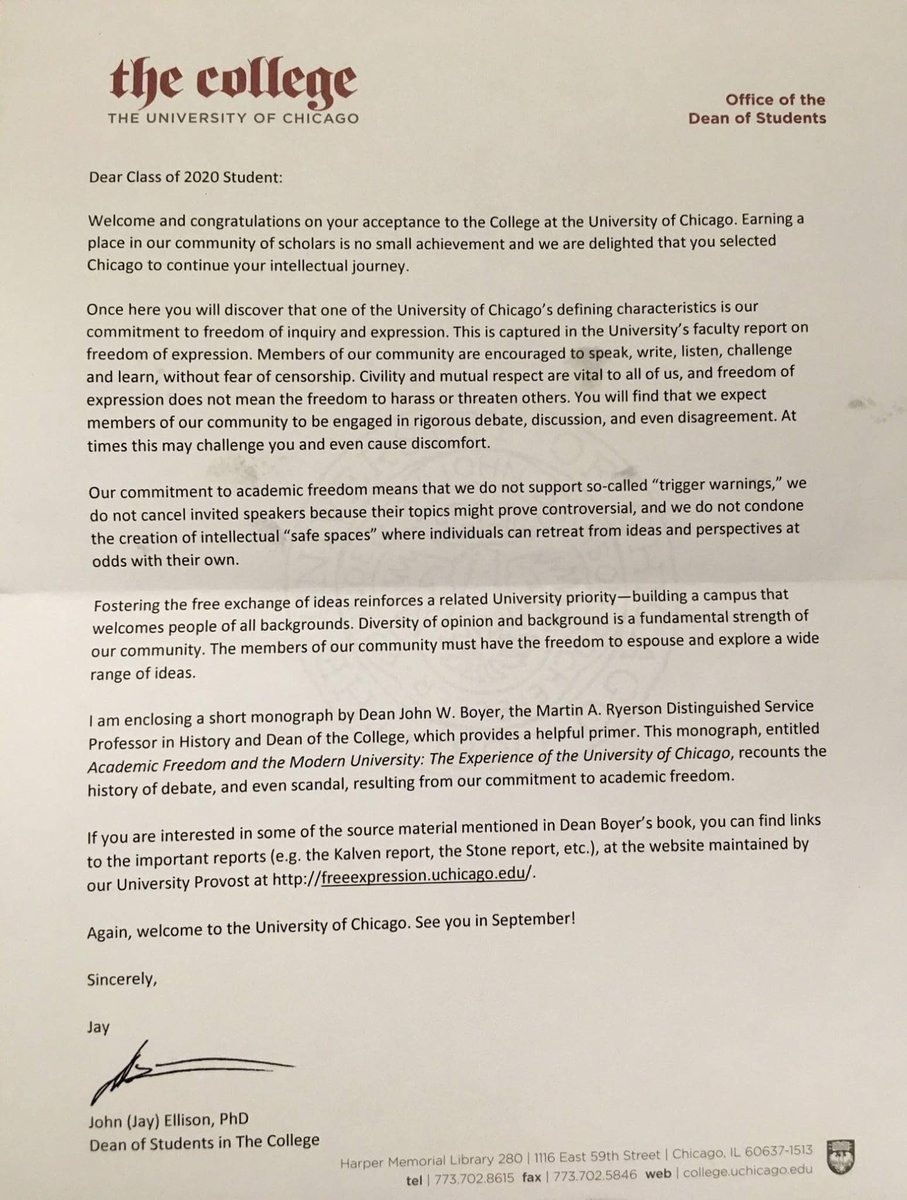
Recently, I read an article, "Univ. of Chicago pushes back on trigger warnings, safe spaces" about a letter written by a dean of the University of Chicago to incoming freshmen. This letter summarizes the university's "commitment to freedom of inquiry and expression." This article inspired this post, so Intellectual Takeout gets some credit. 

In our modern, sensitive society there has been a large increase in political correctness and general fear (or discomfort, possibly) of sharing opinions. This has resulted in some colleges and universities to avoid discussing topics that touch on “racism, classism, sexism, heterosexism, cissexism, ableism, and other issues of privilege and oppression." Further, safe zones, areas where students can escape from topics that can be stressful, have been created in universities. Trigger Warnings, alerts that professors are expected to issue if something in a course might cause a strong emotional response, are also becoming popular.

I'll quote the University of Chicago on safe zones and trigger warnings, "Our commitment to academic freedom means that we do not support so called ‘trigger warnings,’ we do not cancel invited speakers because their topics might prove controversial, and we do not condone the creation of intellectual ‘safe spaces’ where individuals can retreat from ideas and perspectives at odds with their own."

I applaud the University for taking this stance because colleges and universities are supposed to teach students how to think critically and expose students to different ideas. Political views shouldn't be based on emotion, they should be based on facts. Trigger warnings are for emotional safety not to genuinely protect students. Avoiding facts or ideas that are contrary to one's opinion or uncomfortable hurts students instead of helping them. The only way a student can develop opinions completely is to hear other viewpoints and facts that may be uncomfortable to them. 

If you want to read the letter, it's posted below. And here's a link (click on the title) to an article titled "The Coddling of the American Mind" from The Atlantic, it provides an in-depth analysis of safe zones and trigger warnings.


Monday, August 22, 2016

Presidential Election 2016: Why am I voting for Trump?

Let me preface this by saying that Trump was not my first choice in the election this year. As I stated in my first post, I was a Ben Carson supporter and I wanted to vote for him. He was, and still is, my ideal presidential candidate. Carson, like Trump, is against political correctness and Washington cronyism, but Carson, unlike Trump, wasn't boisterous. Carson later endorsed Trump after he had to drop out of the race. His endorsement of Trump didn't surprise me due to Cruz's campaign lying about Carson dropping out before he actually dropped. Carson's endorsement of Trump did contribute towards my decision to vote Trump.

Donald Trump has said some things over the past year that have made me scratch my head, I'm not going to list them because all you need to do is the watch the news to hear them and we'd be here all day. Nonetheless, I am still voting for Trump and here's why: he's not as bad as Hillary Clinton and he has a chance of winning. 

Third Party Candidates
I have accepted that elections are typically a choice between the lesser of two evils, so that eliminates the third party option. Third party candidates don't have a high chance of winning a presidential election and I don't want my vote to go to waste. I have done research on the third party candidates, Gary Johnson of the Libertarian Party and Jill Stein of the Green Party, and I disagree with their parties' platforms and their individual ideas. There are some ideas from both Johnson and Stein that I do agree with. I'll give you some examples in the next paragraph.

Johnson supports term limits for Congress and he says that "his first major act as President will be to submit to Congress a truly balanced budget." There are other ideas that Johnson has that I agree, but I'm actually going to discuss this in another post. The main thing I agree with Stein on is repealing the USA PATRIOT Act, or at least some of it. Johnson and Stein both support the legalization of marijuana and I'm not completely opposed to that. I used to be completely opposed to the legalization of marijuana, but that's something I've changed on over the years. 

Hillary Clinton and her policies
Hillary Clinton is crooked and dishonest with a long list of scandals. I don't think she really cares for this country at all based on her conduct in office. Let me list a few examples: she mishandled Benghazi, the whole email situation, The Clinton Foundation, and the "vast right-wing conspiracy". That last example is reaching back, but it can still apply. She does claim to stand up for women even though she didn't stand up for the women involved with Bill.

Clinton's policies aren't that awe inspiring to me either. I don't believe that our country can pay for debt-free college. Let's remember that the government doesn't have money, they use tax money. The government will have to increase taxes to pay for "debt-free" college, tax hikes do not help the middle class. And that's not the only thing Clinton wants the government to pay for; just think about that.

Specifically, regarding Clinton's tax plan. Her campaign site states, "Hillary will close tax loopholes like inversions that reward companies for shifting profits and jobs overseas." That sounds like a good policy because there are tax loopholes and those shouldn't exist. If she truly believes this, then why are billionaires like Warren Buffett, George Soros, and Michael Bloomberg backing her? I doubt they would want their taxes to be raised, so they must be concerned that Trump will rock the boat. Clinton won't rock the boat, she'll do the same old thing even though it's obviously not working for the country. 

There are other policies I don't agree with, however, I won't discuss all of them in the interest of time. If you would like to read her policies, you can find them on her campaign site: https://www.hillaryclinton.com/


Donald Trump will at least admit that there are problems in America. We know Clinton will do the same thing as she has always done. Trump is going to different and that could be a good different. I'm willing to experiment with electing Trump because it can't get be any worse than Clinton. 

Sunday, August 14, 2016

Introduction

Hello readers, I'm going to keep this short and sweet. Most of you probably know me and that's probably why you're here. For those of you who don't, my name is Zach Smith (that explains the link) and I'm 21 years old. As the title of this blog suggests, hopefully, I'm asking you to read my opinion on things, specifically politics. "Lend me your ears" comes from Julius Caesar by Shakespeare, not "With a Little Help From My Friends" by The Beatles. Even though I like that song it's not my inspiration. 

Those of you who don't know me may be thinking, "Do I really want to hear a millennial talk about politics?" And I don't blame you if you do think that, after all the young voters were a big voting block for Obama. I wasn't old enough to vote in 2008 or 2012 though, so you can't blame me for Obama. 

Anyway, I'm a conservative if you couldn't tell. I would say I'm a Cruz like conservative, but we saw at the GOP convention how Cruz turned out. Cruz only got my vote because Carson withdrew from the race before the North Carolina primary. Trump is my third option and I'll be voting for him, I will not vote for Clinton. I'll get to the 2016 election another time.

My reason for starting this blog is chiefly to give a conservative opinion on what is going on in the world because the mainstream media is biased most of the time. My other reason is to see if I can become a successful enough political blogger to maybe become professional. 

So, my blog is officially ready to be read. I'm aiming at posting every week or two, so stay tuned.

And thanks for reading.